

Author: Simon Daigneault, Product Marketing Engineer, Monolith
Read Time: 6 mins
Engineering teams are under constant pressure to converge quickly. Test budgets are finite, timelines are fixed, and there is a strong incentive to demonstrate progress early. In this environment, optimisation that appears to move fast is often rewarded. However, across many engineering programmes, we repeatedly see the same pattern: teams optimise too early, lock into narrow assumptions, and pay for it later.
This is not a lack of technical competence. In most cases, the engineers involved are highly experienced, statistically literate, and working with well-designed test plans. The issue is more subtle.
It sits in how teams balance exploration and exploitation when deciding what to test next, and when to commit to optimisation.
When optimisation feels fast but creates long-term risk
Early optimisation is attractive because it produces visible gains. Performance improves, targets are met, and confidence builds within the team. From the outside, this looks like efficient engineering.
The problem is that early gains often come from a very limited view of the system. Initial test data is sparse, noisy, and shaped by the assumptions built into the first test plan. When teams exploit these early signals too aggressively, they reinforce what appears to work rather than questioning what is still unknown.

We have seen many projects where optimisation progresses smoothly through early phases, only to stall or reverse later. Validation exposes behaviours that were never tested, sensitivities that were never explored, or interactions that were assumed to be negligible. At that point, the cost of learning increases dramatically.
The decision hiding behind every ‘what should we test next?’
Exploration and exploitation are often described as abstract optimisation concepts, but in engineering, they translate directly into decisions with consequences.
Exploration is the act of reducing uncertainty. It prioritises tests that expand understanding of the system, even when those tests are unlikely to deliver immediate performance improvements.
Exploitation focuses on refinement. It uses current knowledge to push performance higher within regions that appear promising.
Both are necessary. The failure mode appears when exploitation dominates before uncertainty has been reduced sufficiently. At that point, teams are no longer optimising the system itself, but optimising their assumptions about it.
What balancing exploration and exploitation actually means in practice
In practical terms, balancing exploration and exploitation comes down to how uncertainty is treated in test planning. Early in a programme, uncertainty is high across much of the design space, even when local performance appears strong. Models built on sparse data can fit observed results well while remaining poorly informed about nearby or untested regions.
Exploitation reduces uncertainty locally by refining known behaviours, but it does little to improve global understanding. Exploration, by contrast, targets regions where uncertainty remains high or where the model is least confident, even if those tests are unlikely to produce immediate performance gains.
As data accumulates, uncertainty collapses unevenly, and the balance naturally shifts towards exploitation. Without explicitly accounting for this uncertainty, optimisation decisions are driven by apparent performance alone, which is where many programmes encounter late-stage instability.
The optimisation mistake many teams make
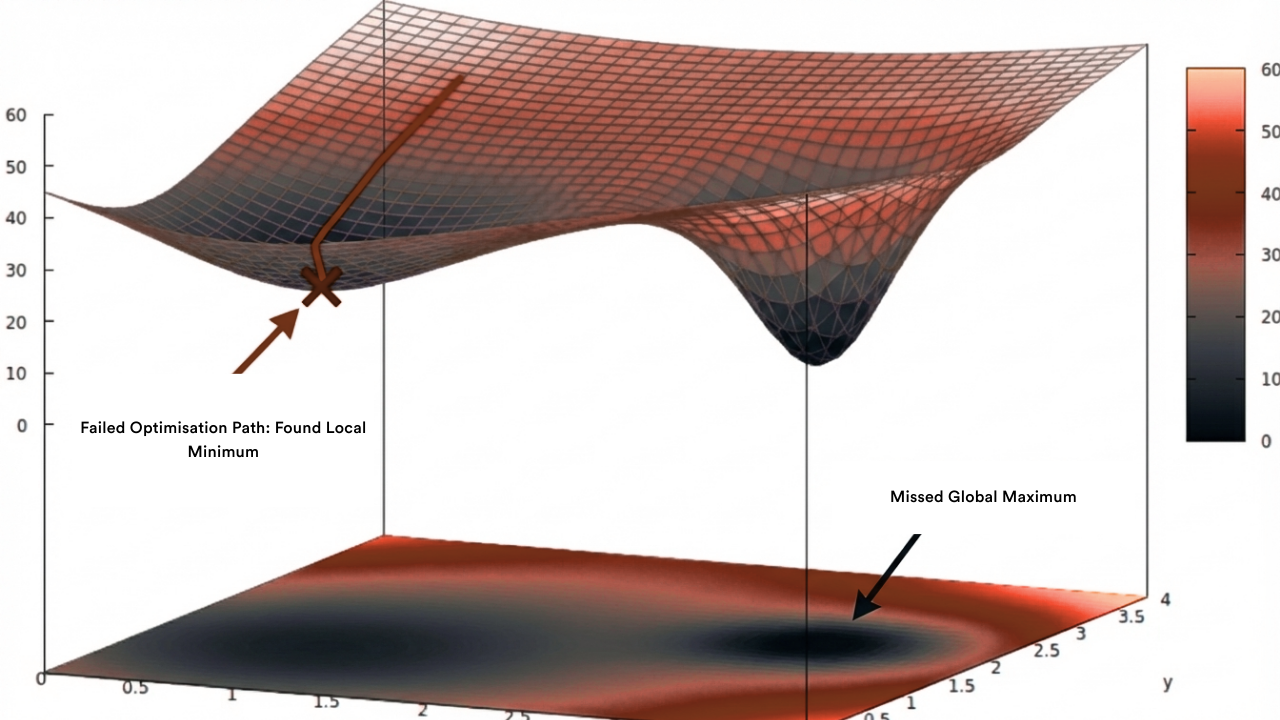
Local optima are easy to recognise once the landscape is visible. During testing, however, teams only see the regions they have explored. Early convergence often reflects where data exists, not where the true optimum lies.
Across projects, one pattern appears repeatedly: teams treat early promising results as confirmation rather than hypotheses.
Once a region of the design space produces good results, test planning often shifts towards refinement. Test points cluster, parameters are tuned, and alternative regions receive less attention. This feels rational. It is also risky.
Early test results carry disproportionate influence because they arrive first. Human judgment, even in highly technical teams, tends to overweight these results. Over time, the test plan becomes narrower, uncertainty remains hidden, and confidence grows faster than understanding.
When this happens, optimisation converges quickly, but often to a local optimum that only becomes visible much later.
Why traditional test plans reinforce false confidence
Traditional design of experiments provides structure and rigour, but it also embeds assumptions. Test plans are usually fixed upfront, based on what is believed to matter most at the start of a programme.
The issue is that complex engineering systems rarely behave exactly as expected. As data is collected, the most informative tests often change. However, many test strategies are not designed to adapt based on what has already been learned.
We frequently hear from teams that their test plan was technically sound, yet still failed to reveal critical behaviours until late in development. In hindsight, the problem was not test quality, but test selection. The plan did not evolve as uncertainty shifted.
When early success causes blind spots
Optimisation rarely fails because teams lack data. More often, it fails because the data available early in a programme creates a stronger sense of understanding than the system can yet support.
This confidence is not deliberate. It emerges naturally from clean datasets, smooth trends, and models that perform well within the operating conditions they have seen so far. When exploitation dominates too early, models become highly accurate in familiar regions, while remaining uncertain elsewhere.
These gaps often remain hidden until later stages, when validation expands the operating window or requirements change. At that point, addressing them typically involves re-testing, redesign, or compromise, all of which are costly and difficult to absorb.
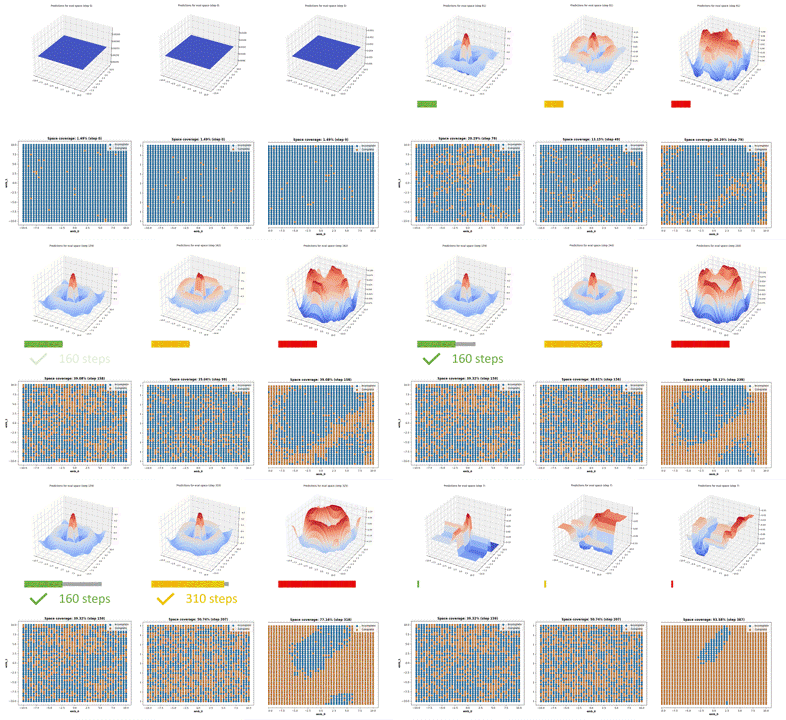
Having a more efficient approach to design of experiments (DOE) means you can find the optimum in fewer steps, and that you may even miss it if you take the wrong steps
In this sense, exploration is less about inefficiency and more about risk management. It provides a structured way to expose uncertainty early, when decisions are still reversible.
How high-performing teams balance the exploration/exploitation trade-off
Teams that consistently avoid these failure modes approach test planning differently. They treat the decision of what to test next as an optimisation problem in its own right.
Rather than asking only how to improve performance, they ask where uncertainty is highest and where additional data would most improve understanding. Early in a programme, this leads to broader exploration. As uncertainty reduces, exploitation naturally becomes more effective.
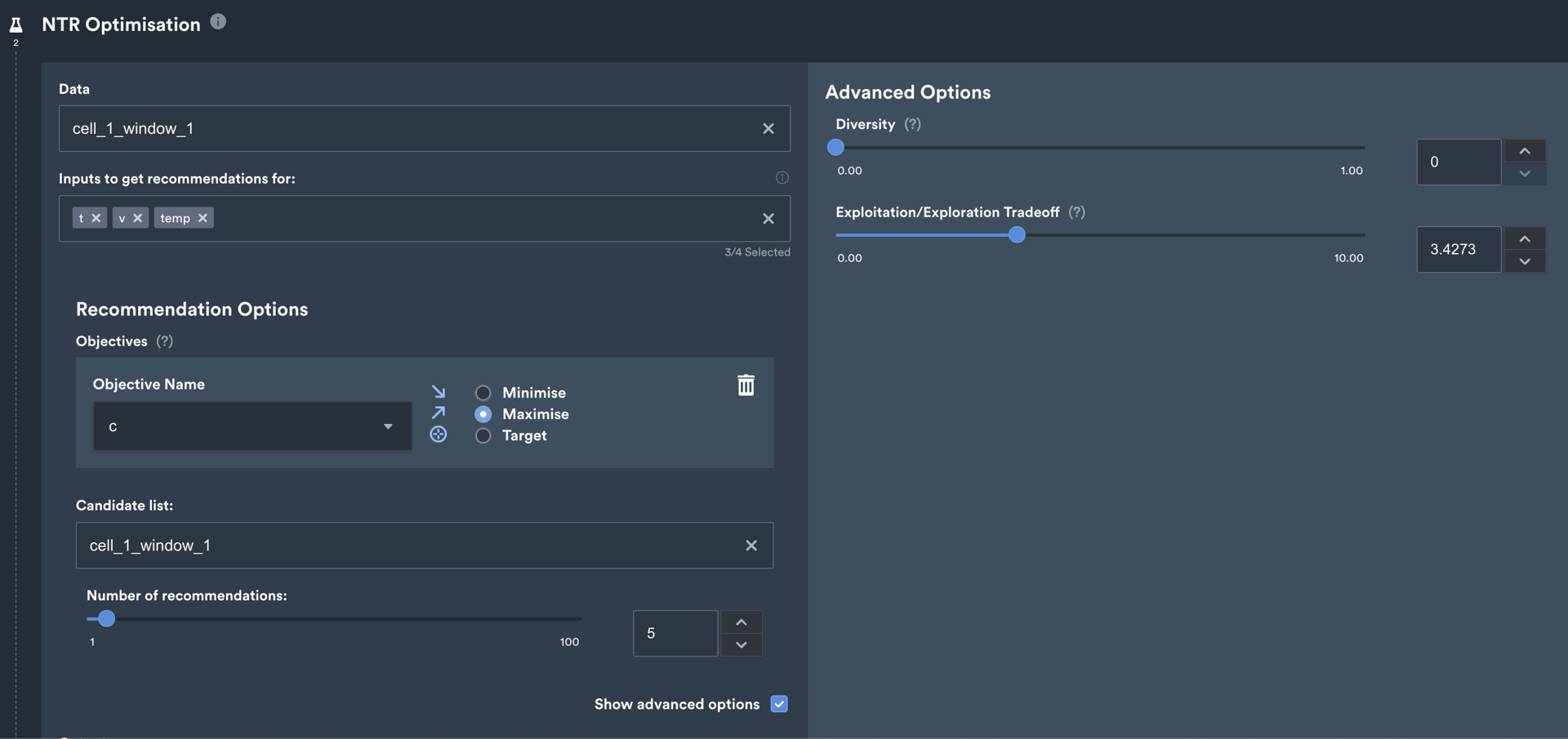
Monolith's optimisation module allows the user to bias the algorithm towards a specific exploration/exploitation tradeoff preference depending on the stage of discovery
The balance between exploration and exploitation shifts continuously. It is not defined by phases or milestones, but by the evolving state of knowledge.
Modern optimisation and active learning approaches formalise this process. By explicitly accounting for uncertainty, they guide test selection towards experiments that maximise learning value, not just immediate performance.
Why better exploration leads to fewer tests
A common concern is that exploration increases test volume. In practice, the opposite is often true.
Poorly chosen exploitation leads to wasted tests, repeated experiments, and late rework. Exploration reduces these inefficiencies by revealing system behaviour earlier, when change is still cheap.
Teams that prioritise learning per test tend to run fewer total experiments, not more. The reduction comes from avoiding unnecessary refinement in regions that ultimately prove irrelevant or unstable.
Fewer tests is not the goal. Better decisions per test is.
Nailing the balance with Monolith
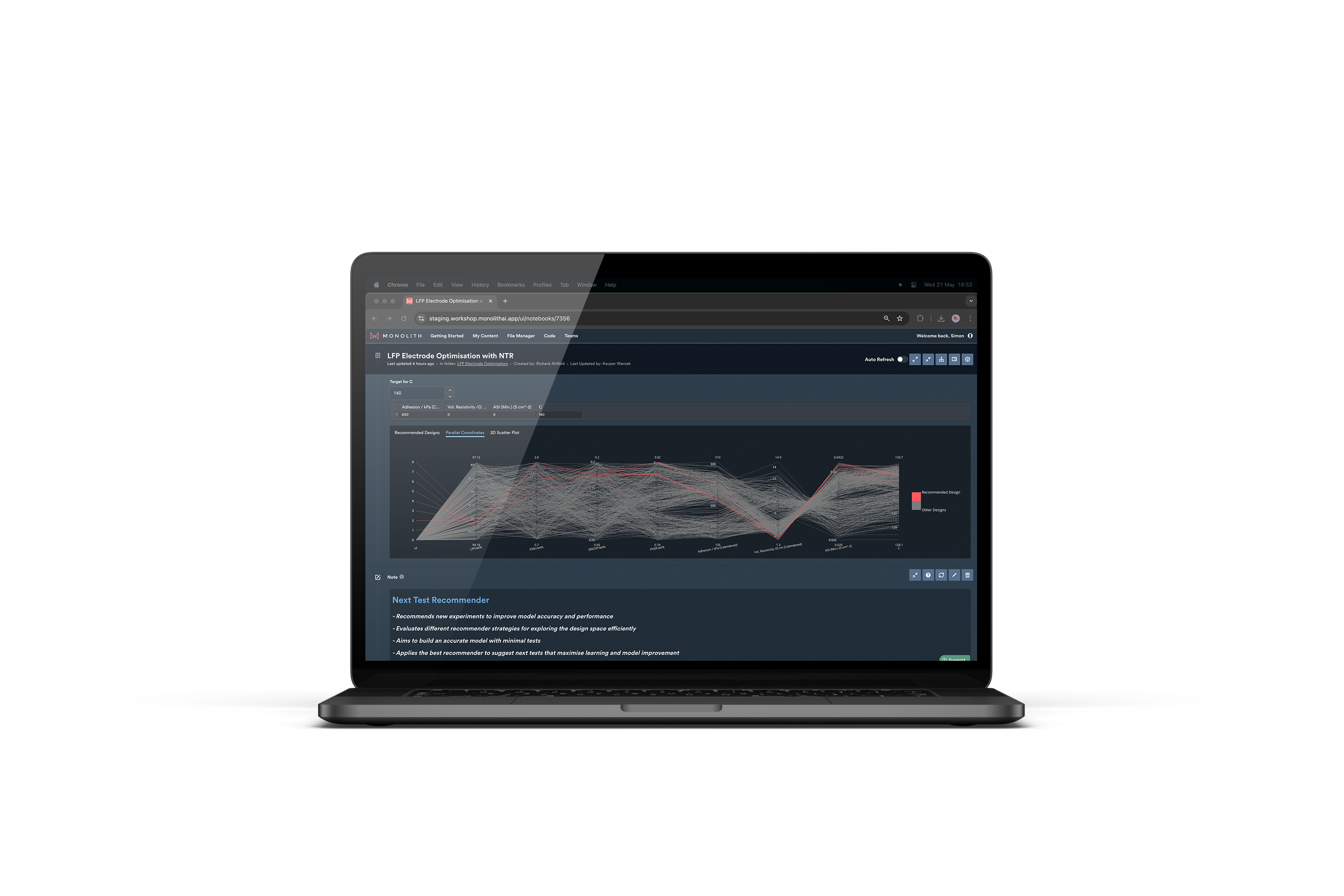 Balancing exploration and exploitation consistently is difficult to do manually, especially as test data accumulates and constraints tighten. Most teams rely on fixed plans early on and intuition later, which makes it hard to adjust decisions as uncertainty shifts.
Monolith is designed specifically to address this gap. Our Test Plan Optimisation and Next Test Recommender tools apply active learning to help teams decide which experiments are most informative at each stage of development. Rather than optimising blindly for performance, test selection is guided by expected learning value and uncertainty reduction.
This allows exploration and exploitation to be balanced explicitly, not informally. As understanding improves, the system naturally shifts towards exploitation without losing visibility into risk.
For test lab managers, the benefit is practical: fewer wasted tests, earlier exposure of blind spots, and optimisation decisions that hold up through validation rather than needing to be revisited late in the programme.
About the author
 An experienced Product Marketing Engineer translating advances in AI into practical insights for battery development. At Monolith, I work across product, engineering, and commercial teams to ensure innovations in our platform deliver real-world value for OEMs. My background includes an MEng in Mechanical Engineering from Imperial College London, with a specialisation in battery testing, and hands-on experience at a battery energy storage startup in pack design, testing, and system integration.